
AI Is Already in the Studio. Show Your Work.
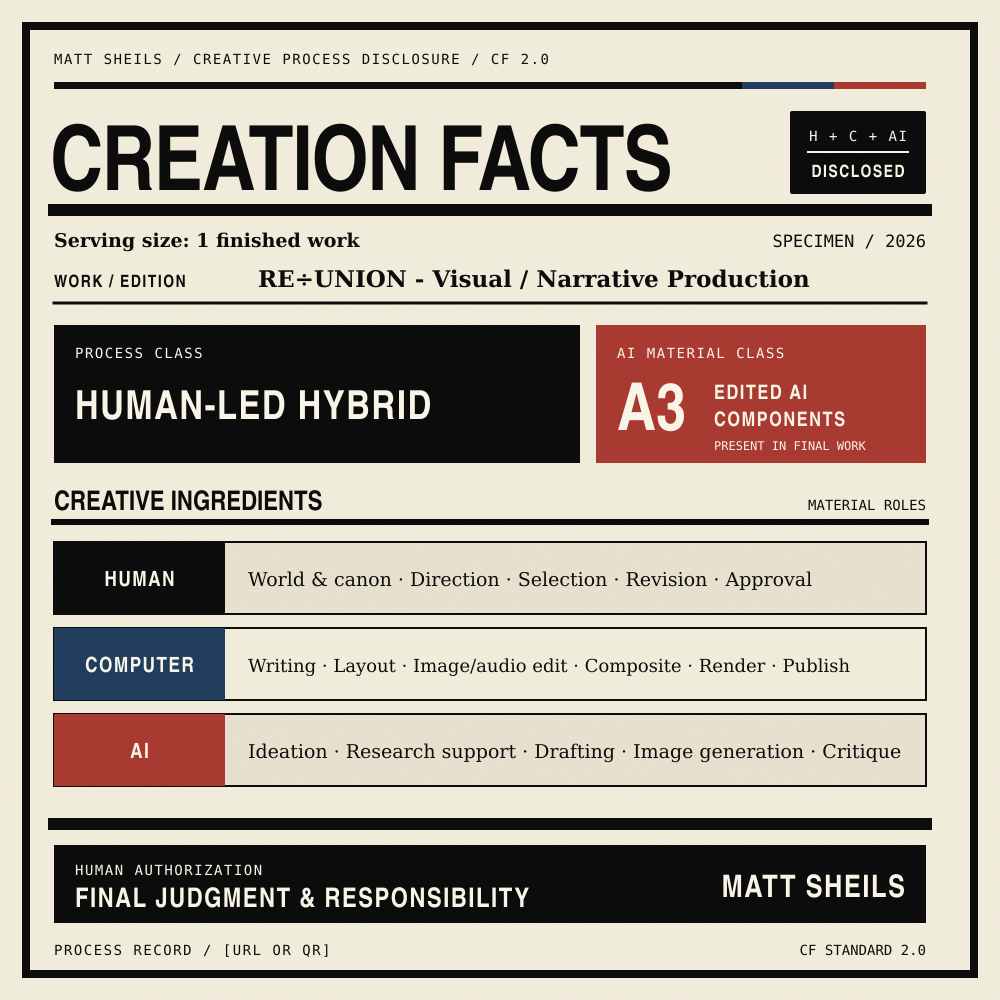
Why I’m putting a Creation Facts label on everything I make.
AI has become a curse word in creative work.
Say it around artists, writers, filmmakers, musicians, designers, or performers and the room can divide almost instantly. To some people, AI means possibility. To others, it means stolen training material, eliminated jobs, synthetic performances, disposable content, and a machine impersonating something human.
Some of that fear is earned.
But the argument usually makes one enormous mistake: it treats the tool and the conduct as the same thing.
“Was AI used?” has become a moral yes-or-no question, even though the answer tells us almost nothing. It does not tell us whether AI removed noise from a damaged recording, generated disposable concept sketches, helped challenge a rule system, imitated a living artist, cloned a performer without consent, or produced a finished work that someone published without meaningfully reviewing it.
Those are not variations of the same act. They are fundamentally different creative and ethical decisions.
We need better questions.
The Machine Was Already in the Room
I have spent decades creating video, virtual tours, photography, print, interactive environments, stories, and design. Long before generative AI arrived, my work was already being shaped through lenses, editing systems, compression algorithms, compositing software, color tools, digital cameras, rendering engines, and computers.
That never made the work less personal. It made the work possible.
I have also drawn by hand, built montages, planned images with pen and paper, and made stop-motion animation one physical movement at a time. I understand the particular intimacy of making something directly with your hands. Purely handmade work still exists, and it deserves admiration and protection.
But it is no longer an honest baseline for judging all modern creative production.
Most digital work is already a collaboration between human intention and machine capability. AI is a more powerful, unpredictable, and ethically complicated participant in that relationship—but it did not invent the relationship.
The question is not whether a machine touched the work.
The question is: What did the machine do, what did the human do, and who is willing to stand behind the result?
“Pro-AI” and “Anti-AI” Are Not Serious Enough
The most interesting creative voices are not landing neatly on one side.
George Lucas has spent his career turning unavailable technology into available storytelling. Industrial Light & Magic, digital editing, digital cinematography, computer-generated environments—his work repeatedly challenged the accepted boundary between filmmaking and technology.
In a July 2026 interview with A Rabbit’s Foot, Lucas described AI’s adoption in filmmaking as progress that will not be stopped. More importantly, he returned responsibility to the person using it: “Whatever you do, you should be recognised.”
That last point matters more to me than the prediction. Technology may be inevitable. Accountability is a choice.
James Cameron embodies the same tension. When he joined the board of Stability AI, he described the convergence of generative AI and CGI as a way to unlock new forms of storytelling. Yet in 2025 he called synthetic actors “horrifying” and the opposite of performance capture, because his digital characters still begin with the choices and performances of real actors.
That is not hypocrisy. It is a line.
In music, Peter Jackson’s team used machine-learning-assisted source separation to isolate John Lennon’s voice from a compromised cassette recording. That allowed Paul McCartney and Ringo Starr to complete “Now and Then.” As the Beatles’ official production history makes clear, the technology preserved and separated Lennon’s actual performance; it did not manufacture a new Lennon performance from a prompt.
Again: a line.
By 2026, Spotify and Universal Music Group were announcing licensed, AI-powered tools for fan-made covers and remixes built around consent, credit, and compensation for participating artists and songwriters. Whether that particular model succeeds or not, the principles are more useful than a blanket declaration that all AI music is either innovation or theft.
Writers are drawing distinctions too. The Authors Guild remains sharply critical of unlicensed training and the replacement of human writing. Yet its updated 2026 best practices explicitly state that different uses should not be treated as ethically equivalent. Background research, proofreading, unedited generated prose, and deliberate imitation do not carry the same risks. The Guild also recommends public disclosure when substantial AI-generated text remains in a published work.
Performers have demanded similarly specific protections. The 2025 video-game agreement and 2026 film and television agreement described in SAG-AFTRA’s AI policy timeline focus on consent, disclosure, compensation, and restrictions on digital replicas—not on pretending the underlying technology can be wished out of existence.
Across industries, the mature conversation is becoming less about whether AI exists and more about where it is allowed to act, whose work it depends upon, and what must be disclosed.
What AI Actually Did for RE÷UNION
My upcoming RE÷UNION card game is the clearest example I can offer.
RE÷UNION did not begin with a prompt asking a machine to make me a product. It began with a human-written world: characters, histories, relationships, locations, visual motifs, moral conflicts, and a central idea about reality being shaped by what is witnessed and recorded.
The card game had to belong to that world. A beautiful card that contradicted the character was wrong. A clever rule that broke the story’s internal physics was wrong. A balanced mechanic that did not feel like RE÷UNION was still wrong.
Building the initial 24-card test kit has involved close to 100 hours of AI-assisted conversation, comparison, revision, and review. AI helped me:
Pressure-test rules and expose edge cases.
Compare card abilities, Influence values, sockets, effects, reach, and scoring.
Reconsider weak mechanics after physical playtesting.
Translate written characters, places, artifacts, and moments into visual directions.
Review artwork for narrative consistency, historical detail, anatomy, composition, and brand language.
Organize revisions across the cards, instruction manual, examples, and supporting material.
Then came the work no system could own for me.
I decided what the game was about. I wrote the source world. I selected what belonged. I rejected what did not. I printed and handled the cards. I played the game, watched where it stalled, felt where it became confusing, changed the rules, rebuilt the explanations, and approved the final material.
AI did not know when the game felt wrong.
I did.
Without AI, the project would not have reached the same level of precision, consistency, or momentum in the same span of time. Without human authorship and judgment, it would not be RE÷UNION at all.
Both statements are true.
There was no magic button. There was a faster, more responsive creative room—and I still had to direct the room.
A Receipt, Not an Apology
That is why I created CREATION FACTS, a compact Human / Computer / AI Process Disclosure that I can place on future creative work.
It borrows the immediate readability of a nutrition label without pretending to be a government rating or independent certification. Its purpose is simple: tell the audience how the work was made.
The label identifies:
The overall process class.
Whether AI-originated material remains in the finished work.
What the human contributed.
What conventional computer tools contributed.
What AI contributed.
Which human approved the release and accepts responsibility for it.
It does not attempt to declare a project “63% human” or “22% AI.” Creative contributions do not separate into honest little measuring cups. One AI-generated concept might require hours of human art direction, compositing, typography, rewriting, and correction. One hand-drawn element might define the identity of an otherwise digital production.
Roles are more truthful than percentages.
The label’s most important field is not the AI classification. It is the human authorization at the bottom.
That is the signature. That is the person saying: I reviewed this. I chose this. I am not hiding how it was made, and I accept responsibility for putting it into the world.
Not an apology.
Not an alibi.
A receipt.
Transparency Is Not a Free Pass
A disclosure label does not resolve the hardest arguments surrounding AI.
It does not settle whether every training dataset was ethically assembled. It does not restore a job that was eliminated. It does not make an unauthorized voice clone acceptable. It does not transform careless output into good work. It does not excuse plagiarism, imitation, deception, factual errors, or the removal of human collaborators who should have been hired and paid.
Transparency is not absolution.
But opacity makes every one of those problems worse.
My standard is straightforward:
Consent when a person’s identity, voice, likeness, or protected work is involved.
Credit for the humans whose contributions shaped the finished piece.
Compensation when someone’s work is licensed or commissioned.
Disclosure when AI materially participates or remains in the final work.
Human accountability for every decision made before release.
Even the legal framework is beginning to reflect this distinction. The U.S. Copyright Office concluded in its 2025 report on AI and copyrightability that using AI as an assistive tool does not block copyright protection. What matters is whether a human determined sufficient expressive elements through authorship, arrangement, or modification. A prompt alone is not the same as authorship; meaningful human control still matters.
That is a legal distinction, not a complete ethical philosophy. But it reinforces the practical truth: using AI does not answer the authorship question. It begins it.
Provenance Is Becoming Part of the Work
The broader creative world is already moving in this direction.
Adobe describes Content Credentials as an industry-standard “digital nutrition label” that can record who created a piece, whether it was captured, AI-generated, or edited, and how it changed over time. That technical provenance can travel with a file.
CREATION FACTS approaches the same trust problem from the human side. It is a visible, plain-language account of roles, judgment, and responsibility.
We need both.
Metadata can tell us what happened to a file. A creator should still be willing to tell us what happened in the room.
The Future Is Not Human Versus Machine
I do not believe the future of creative work will divide cleanly into “human work” and “AI work.” Those categories are already too blunt for the processes happening around us.
The more meaningful divide will be between intentional work and careless output. Between disclosed process and concealed process. Between technology used to extend a point of view and technology used to avoid having one. Between work someone is willing to sign—and material no one wants to take responsibility for.
I will not apologize for using AI to expand what I can imagine, test, revise, and build.
I will not hide it either.
In RE÷UNION, what is witnessed and recorded helps determine which version of reality survives. CREATION FACTS applies a version of that principle to the work itself: record the process clearly before assumption, fear, or marketing language rewrites it for us.
AI is already in the studio.
Now show your work.
Selected References
“The Last Picture Show: A Conversation with George Lucas” — A Rabbit’s Foot, July 2, 2026
James Cameron Joins Stability AI’s Board of Directors — Stability AI
“James Cameron says AI actors are ‘horrifying to me’” — The Guardian
Spotify and UMG Announce Licensing Agreements for AI-Powered Fan Covers and Remixes — May 21, 2026
AI Best Practices for Authors — The Authors Guild, updated May 11, 2026
Copyright and Artificial Intelligence, Part 2: Copyrightability — U.S. Copyright Office
